


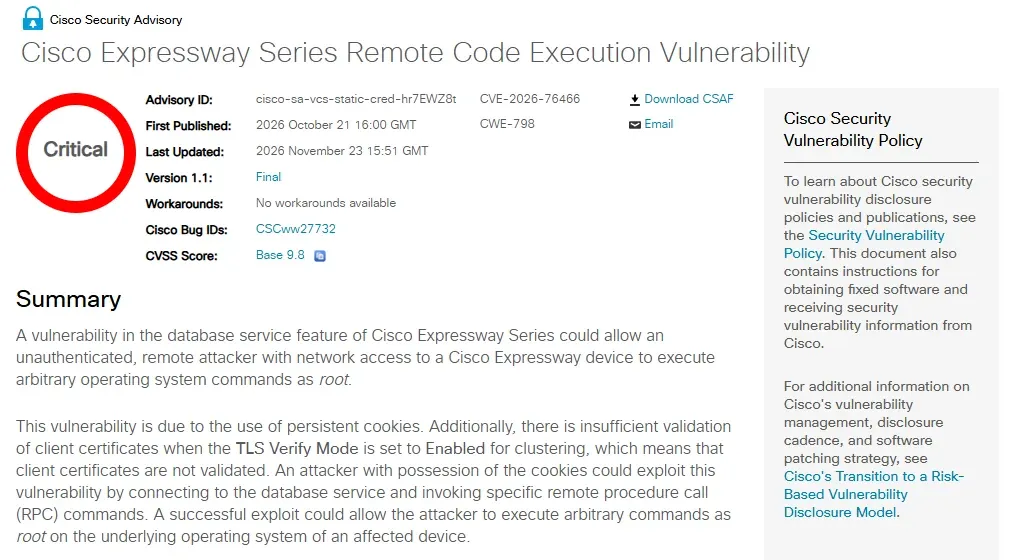
| CVE ID | CVE-2026-76466 |
| Advisory | cisco-sa-vcs-static-cred-hr7EWZ8t |
| Full Title | Cisco Expressway Series Remote Code Execution Vulnerability |
| Weakness | Use of hard-coded credentials, CWE-798 |
| Severity | Critical |
| CVSS Score | 9.8 / 10 |
| Privileges Required | None |
| Affected | Expressway-C and Expressway-E configured in a cluster |
| Workarounds | None |
| CISA KEV | Added November 20, 2026, federal due date November 23, 2026 |
| Fixed In | X15.5.20 |
Affected Versions and Patches
| Your release | What to do |
|---|---|
| X15.5.3 and earlier X15 releases | Upgrade to X15.5.20 or later |
| X14 and earlier | Migrate to a fixed release, X15.5.20 or later |
Cisco lists no workaround, so upgrading is the fix. The patch shipped in the October 2026 hardening release, the same build that fixes eight other Expressway flaws covered below. Check the Cisco advisory for later revisions. Version 1.1 went out on November 23.
What This Means for Your Business
Expressway is the box that lets Webex and Cisco calling work for people outside the office, so it usually faces the internet. This flaw lets an attacker who reaches it take full control without a password. From there they sit on a trusted server at the edge of your network. If your company uses Cisco video or phones for remote staff, ask today whether your Expressway is clustered and on X15.5.20.
What Is Happening
The flaw is in the database service Expressway uses to keep cluster members in sync. Cisco says it comes from persistent cookies, combined with client certificates not being checked when TLS Verify Mode is enabled for clustering. An attacker who has those cookies and can connect to the database service can send it commands that run as root.
Only Expressway-C and Expressway-E systems configured in a cluster are listed as affected, on both virtual machines and appliances. A single standalone Expressway is not in Cisco’s affected list.
Cisco published the advisory on October 21. CISA added the CVE to its Known Exploited Vulnerabilities catalog on November 20 and gave federal agencies until November 23 to act, which is unusually short. Cisco’s updated advisory notes the KEV listing but says Cisco has no direct evidence of active exploitation. Treat it as exploited anyway: CISA only lists flaws it has evidence for.
Fix Steps
1. Find your version. Sign in to the Expressway web interface and open Status, then Overview. The software version is listed there. Do this on every cluster peer.
2. Check for a cluster. If the system has cluster peers configured, it is in scope. Expressway-C and Expressway-E pairs are often both clustered, so check both sides.
3. Back up. Take a backup from the Expressway maintenance menu and a snapshot of each virtual machine before you upgrade.
4. Upgrade to X15.5.20. Download X15.5.20 or later from Cisco Software Central and upgrade each peer, following Cisco’s cluster upgrade order. Systems on X14 or earlier have no patch on that train and need a migration to X15.
5. Confirm. Recheck Status, then Overview on every peer and confirm the version reads X15.5.20 or later.
Look for Signs of Compromise
CISA flagged this CVE for forensic triage, so patching alone is not the end of it for a server that faced the internet. Review the Expressway event log for admin sign-ins, configuration changes and restarts you did not make. Rotate the admin passwords and any certificates or keys stored on the system if anything looks wrong, and check outbound connections from the Expressway to addresses you do not recognize. If you find something unexplained, treat the box as compromised and rebuild it from a known-good release.
The Other Flaws Fixed in X15.5.20
Cisco’s October 2026 hardening release advisory covers CVE-2026-76490 through CVE-2026-76497, rated High with a top score of 8.6. Cisco says none of those are known to be exploited, and the same X15.5.20 upgrade fixes them all.
Ask Your IT Person
Do we run Cisco Expressway, and is it clustered? Get a yes or no for both.
What version is every peer on? The answer should be X15.5.20 or later.
Did anyone review the logs? An internet-facing box on the exploited list deserves a look, even after the patch.
Related Posts
vCenter CVE-2026-123890: Patch the 9.8 Auth Bypass
Outlook CVE-2026-124194: Windows Update Won’t Fix It
November 2026 Patch Tuesday Known Issues and Fixes
Need help patching Cisco Expressway or checking it for compromise? Contact Rain City Techworks.